
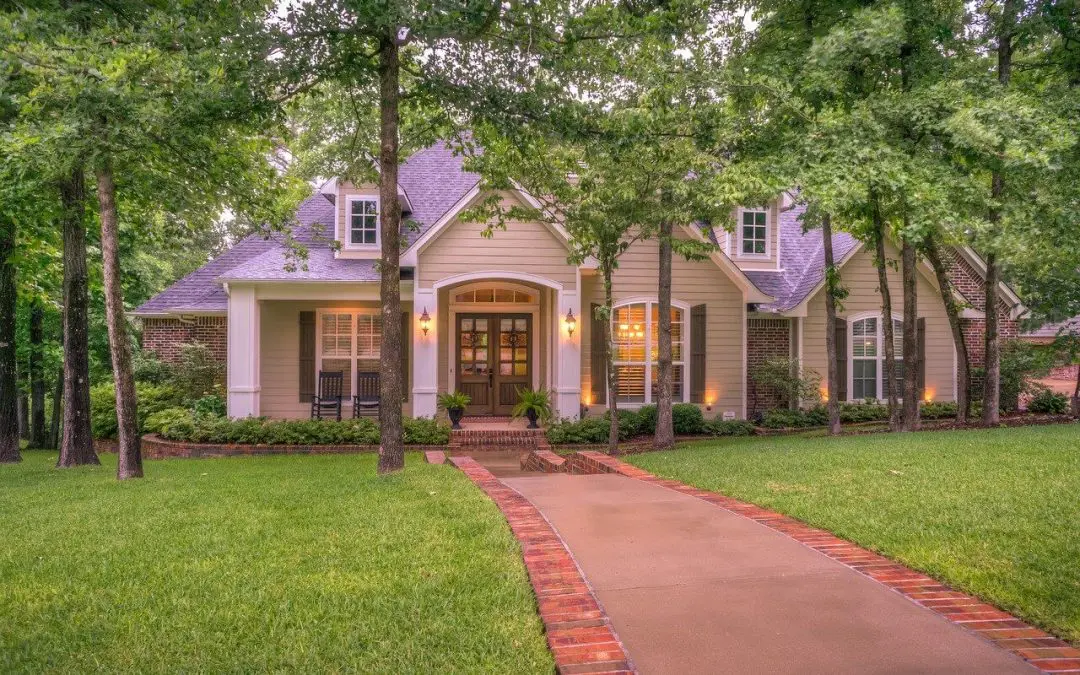
Curb appeal that genuinely elevates a home’s appearance involves understanding how the eye moves across a facade, what creates visual balance, how landscaping scale affects the relationship between the home and the ground it sits on, and how the home looks not just in afternoon light but at dusk and in winter. Improve curb appeal with these principles in mind to produce results that last longer, photograph better, and make a stronger impression than any single cosmetic update.
Symmetry, Focal Points, and What Draws the Eye First
On most homes, the front door is the natural focal point. When the landscaping, lighting, and architectural elements around the entry reinforce that focal point, the home reads as designed rather than assembled. Symmetry, matched plantings, matched fixture pairs, and balanced hardscape on either side of the entry create the visual calm that registers as elegant and intentional. It doesn’t require identical elements, just balanced visual weight. A large planting on one side needs a corresponding element of similar visual presence on the other. For most homeowners looking to improve curb appeal efficiently, working with symmetry around the entry produces the fastest, most reliable result.
Layered Landscaping That Improves Curb Appeal Year-Round
The landscaping condition that most consistently undermines curb appeal is a single layer of plants. This produces a flat, undifferentiated look that reads as maintenance rather than design. Layered landscaping, low groundcover at the front, medium shrubs in the middle, and taller structural plantings at the back creates the depth and dimension that makes a landscape look designed from the street. Each layer contributes at a different season: groundcover provides texture when shrubs are dormant, mid-level shrubs provide year-round structure, and the taller back layer gives the composition vertical presence from a distance. The goal is a planting scheme that looks intentional in January as well as June. Hardscape elements, such as a defined pathway, a low garden border, give the landscape an architectural edge that plantings alone don’t provide. The transition between lawn and planting bed is one of the most visible details from the street, and a clean, defined edge communicates care in a way that an undefined boundary doesn’t.
Improve Curb Appeal After Dark With Thoughtful Lighting
Architectural lighting that highlights the home’s features, uplighting that emphasizes facade texture, path lighting that creates a warm approach to the entry, and a well-chosen pair of entry fixtures at the right scale, gives the home a nighttime identity most properties never achieve. Warm white sources in the 2700K to 3000K range make exterior surfaces, plantings, and architectural details look their best after dark, while cooler sources produce a flat, institutional quality regardless of the fixture. To improve curb appeal comprehensively, across seasons, times of day, and points of approach, is to treat the home’s exterior as a composed environment rather than a collection of individual updates.
Frequently Asked Questions (FAQs)
What is the fastest way to improve curb appeal before listing a home for sale?
The updates with the fastest visible return are a freshly painted front door, clean and defined landscape bed edges, fresh mulch, and power washing of the driveway and walkway. These can be completed in a weekend and address the most visible conditions. Adding a matched pair of entry fixtures if the existing ones are dated, and ensuring house numbers are visible and contemporary, completes the entry zone that makes the strongest impression on buyers.
How much does it cost to improve curb appeal significantly?
Meaningful improvement can be accomplished for a few hundred dollars through paint, mulch, and edge definition, or several thousand through new landscaping, hardscape, and exterior lighting. The highest-return improvements relative to cost are paint, defined landscape edges, and entry lighting, all producing significant visual impact for modest investment.
Does curb appeal actually affect home value?
Yes, curb appeal has a documented relationship to perceived value and sale price. Buyers form an opinion of a home within seconds of seeing it from the street, and that impression affects how they evaluate everything inside.
How do I improve curb appeal on a home with a challenging facade?
Strong landscaping that creates vertical interest and draws the eye toward the entry reduces the visual weight of a flat facade. A bold front door color creates a focal point the architecture doesn’t naturally provide. Window boxes, shutters, and exterior lighting add detail and dimension to a surface that lacks it architecturally.
What landscaping mistakes most consistently undermine efforts?
Planting shrubs too close to the foundation and allowing them to grow against the house eventually hides the base of the structure and creates moisture conditions that affect the building envelope. The second most consistent mistake is planting for immediate impact without accounting for mature size. Choosing plants for mature size first and maintaining defined edges are the disciplines that improve over the long term rather than just in the first season.
Secure Home Inspections proudly serves property owners and buyers throughout Upstate NY. Schedule your commercial inspection with Secure Home Inspections today.